

The One Mistake That Makes Every Room Look Off
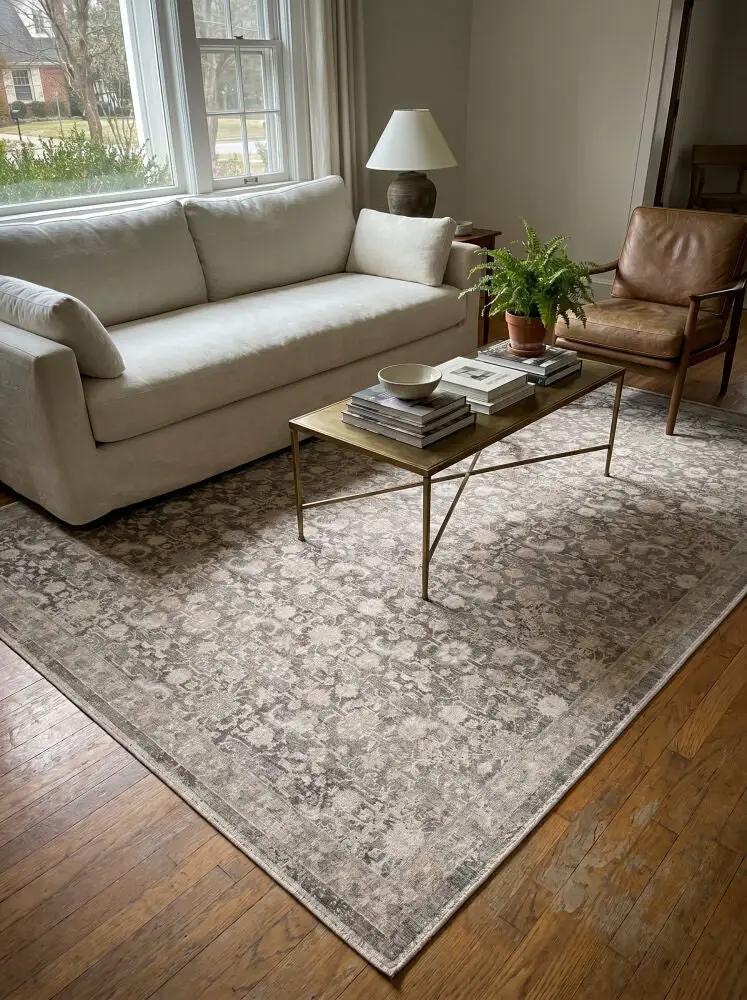
We see it constantly. A beautiful sofa. Thoughtfully chosen throw pillows. A coffee table with just the right amount of character. And then, floating in the middle of it all, a rug that's about two sizes too small.
It's the most common decorating mistake we come across, and honestly, it's an easy one to make. Sizing a rug from a product page, without the room in front of you, is genuinely hard. You're converting measurements in your head, second-guessing yourself, and probably defaulting to something that feels "safe." Safe usually means too small.
We've spent years helping customers figure out how to choose the right rug size for their specific rooms, and the good news is there are clear, reliable principles that take the guesswork out. Once you know them, you won't look at a rug listing the same way again.
Start with the Room, Not the Rug
Before you browse a single collection, measure your room. Write it down. Then subtract roughly 18 to 24 inches from each wall, which is the amount of bare floor you want showing around the perimeter of the rug in most rooms. That number is your target rug zone.
For a 12 x 15 foot living room, that means your rug should land somewhere around 8 x 10 or 9 x 12. Not 5 x 8. Not 6 x 9.
Here's where people get tripped up: they measure the space between their furniture rather than the room itself. That leads to undersizing every single time. Always start from the walls out.
Living Rooms Have Their Own Logic
The living room is where sizing questions get the most contentious, mostly because there are a few different schools of thought and they all have merit depending on your layout.
All legs on the rug. This is the most cohesive look. Every major furniture piece sits fully on the rug, which visually unifies the seating area into a single, intentional zone. It requires a larger rug, typically 9 x 12 or bigger for most standard living rooms, but the result is worth it.
Front legs only. A slightly more casual approach where just the front legs of sofas and chairs rest on the rug. This works well in smaller rooms or when you're working with a specific rug size that doesn't quite accommodate everything. The key is consistency: if one sofa has front legs on, all seating should.
No legs on. We'll be honest: this only works in very specific scenarios, like a small accent rug in a tight reading nook. In a main living area, a rug with no furniture touching it tends to look like it wandered in from another room.
For most living rooms, we'd point you toward our area rug collections starting in the 8 x 10 range as a floor minimum, and size up from there based on your layout.
Dining Rooms Are Actually Easier
This is the one room where the rule is almost universal: your rug should extend at least 24 inches beyond the edge of the table on all sides. That clearance ensures chairs stay on the rug even when pulled out, which matters both for aesthetics and for preventing chair legs from catching on the rug edge.
For a standard 6-person rectangular dining table (roughly 36 x 72 inches), a 8 x 10 rug is usually the minimum. For an 8-person table, go to 9 x 12.
Round tables pair beautifully with round rugs, which is something worth considering if you haven't explored that option yet. We carry a solid selection of round area rugs in sizes that work well under circular dining tables and in breakfast nooks.
According to Architectural Digest's rug sizing guide, the 24-inch clearance rule is widely endorsed by interior designers precisely because it prevents the awkward "half-on, half-off" chair situation that makes rooms feel unfinished.
Bedrooms, Hallways, and the Spaces People Forget
Bedrooms are forgiving, but there's still a right answer. For a queen bed, a 8 x 10 rug placed so that 18 to 24 inches of rug extend on both sides and at the foot of the bed works well. For a king, step up to a 9 x 12. If you're working with a smaller budget or a smaller room, two runners on either side of the bed are a classic workaround.
Hallways are a different challenge. The goal is a runner that leaves roughly 4 to 6 inches of bare floor on either side, which frames the runner rather than cramming it wall to wall. Most standard hallways work well with a runner in the 2'6" wide range. We offer hallway runners in multiple sizes, including the 2'6" x 10' format, which covers most standard entry halls and corridors comfortably.
Home offices and reading corners often get overlooked. For a dedicated desk area, even a smaller 5 x 7 or 5'3" x 7'6" rug defines the zone without overwhelming the space. It's less about coverage and more about intention.
A Note on Round Rugs
Round rugs follow slightly different logic because they're often used as focal points rather than full-room anchors. In a living room with a circular coffee table, a round rug can be stunning. The diameter should be large enough that the coffee table sits on it comfortably with room to spare.
For entryways, a round rug in the 4 to 6 foot diameter range creates a welcoming moment without overwhelming a tight space. The Interior Design Society notes that round rugs work particularly well in rooms with strong angular furniture because they soften the lines and add visual flow.
What We Always Tell People Before They Order
Before you confirm your size, do this: tape out the dimensions on your floor with painter's tape. It takes five minutes and it has saved more orders from being the wrong size than anything else. Stand in the room. Sit in the furniture you have. Walk around it. That rectangle of tape will tell you immediately if you need to go bigger.
And if you're ever unsure, size up. A rug that's slightly larger than you expected almost always looks better than one that's slightly smaller. Our catalog runs from compact 2 x 3 accent sizes all the way up to 9'10" x 12'10" room-filling formats, so there's room to find the right fit.
Ready to find the right size? Browse our full collection at Rug Resources and filter by size to see exactly what's available in the dimensions your room needs. If you have a question about a specific layout, reach out to us directly. We're happy to help you get it right.

Share:
Why Do Rugs Shed? What’s Normal and What Isn’t