

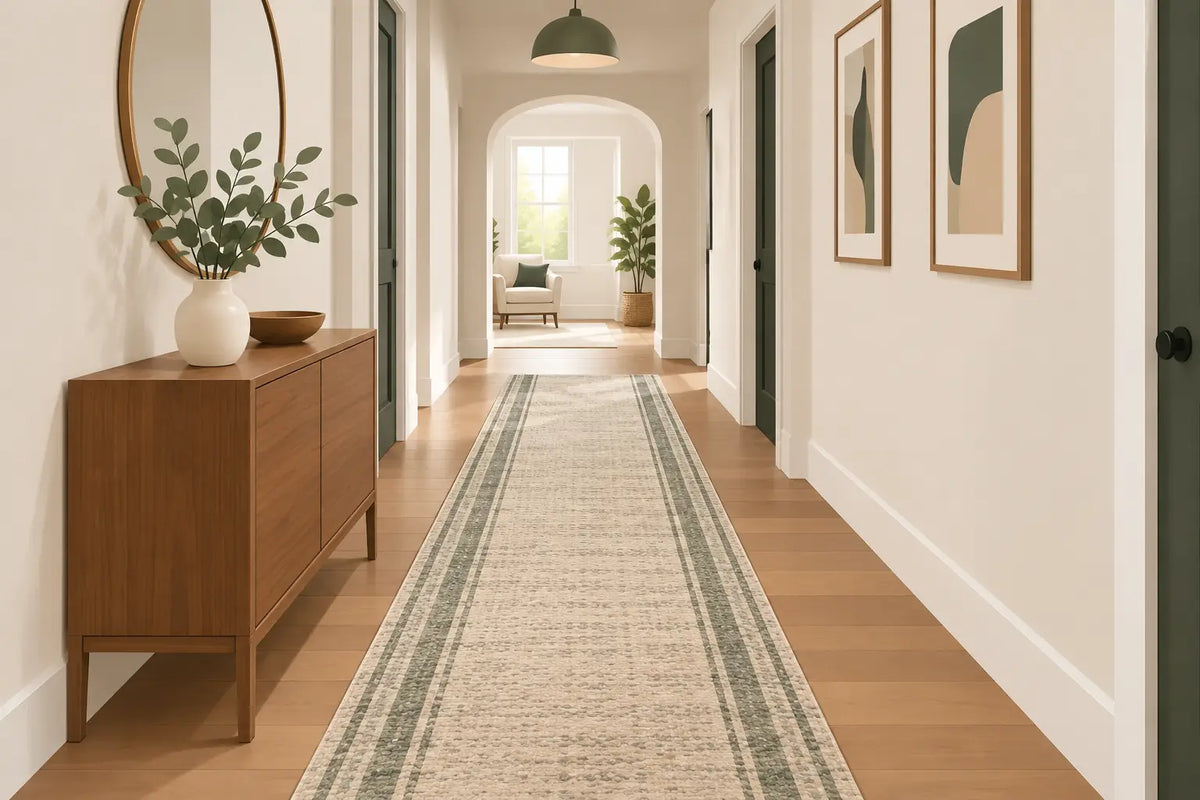
A long hallway can feel like a pass-through until a beautiful runner changes the experience. Runner rugs bring warmth underfoot, soften hard flooring, and give the eye a graceful path to follow from one room to the next. More than a practical finishing touch, the right runner can make an entry feel welcoming, a galley kitchen feel more considered, or a narrow landing feel like part of the home’s larger design story.
The best choice balances proportion, performance, and personality. A richly patterned vintage-inspired runner may hide the evidence of a busy household beautifully, while a quiet neutral design can create tranquil harmony in a sunlit hall. The goal is not simply to fill an empty strip of floor. It is to select a piece that gives the space purpose.
Start With the Right Runner Rug Size
Scale is the detail that separates a hallway that feels thoughtfully furnished from one that feels crowded. Before shopping, measure both the length and width of the open floor area, accounting for door swings, heating vents, and any furniture that narrows the passage.
For most hallways, leave roughly 3 to 5 inches of visible flooring on each side of the runner. This border gives the rug room to breathe and keeps the arrangement from looking wall-to-wall. In a wider hallway, a 2'6" or 3' runner often has a confident, tailored look. Narrower spaces may call for a 2' or 2'3" width.
Length deserves just as much attention. A runner should feel intentional rather than like a small rug placed at random. In a long corridor, choose a size that reaches through most of the space while leaving a comfortable margin at both ends. For an entry, a shorter runner can frame the threshold without interfering with the front door. In kitchens, measure the full working path, especially the area between the island and cabinetry or along the sink wall.
If an exact standard size does not suit the room, it is usually better to choose slightly shorter than too long. A runner that bunches near a doorway or touches baseboards loses its polished effect quickly.
Where Runner Rugs Work Hardest
Runner rugs are natural fits for hallways, but their appeal extends well beyond them. They offer a welcoming layer wherever a home has a narrow, high-use path.
In an entryway, a durable runner establishes the mood immediately. A subtle border design can lend timeless elegance to a traditional home, while a modern geometric pattern brings energy to a simpler setting. Look for a low-profile pile so exterior and interior doors can open comfortably.
In a galley kitchen, a runner brings softness to the places where you stand most often. It can visually connect cabinetry at either end of the room and make a functional space feel more personal. Since spills are part of kitchen life, washable constructions, performance fibers, and detailed patterns are especially practical here.
Beside a bed, runners create a soft landing in rooms where an oversized area rug is not the right fit. A pair of coordinating runners can also be a smart choice in a room with an awkward layout, giving each side of the bed an inviting finish without covering beautiful hardwood floors.
Laundry rooms, mudrooms, and dressing areas benefit too. These spaces often have hardworking surfaces and limited square footage. A runner adds comfort and color without asking for much floor space in return.
Choose Materials for Real Life
A runner’s material affects how it feels, how it wears, and how much care it requires. There is no single best fiber for every home. The right one depends on traffic, texture preferences, pets, children, and how much maintenance you want on your weekly list.
Wool has a naturally luxurious hand and a depth of color that makes even quiet designs feel artfully crafted. It is an excellent choice for bedrooms, formal halls, and living spaces where comfort and lasting character matter most. Wool can shed when new, particularly in higher-pile styles, and it benefits from thoughtful care. That trade-off is often worthwhile for shoppers who want an heirloom-inspired look and a softer feel underfoot.
Synthetic fibers such as polypropylene and polyester are often ideal for busy entryways, kitchens, and family-friendly halls. They are valued for their durability, approachable price point, and resistance to everyday stains. Many also offer a pleasingly soft finish, making them a practical choice without sacrificing style.
Natural fibers, including jute and sisal, deliver distinctive texture and organic warmth. They are especially lovely in coastal, global, and relaxed transitional interiors. Because their weave can feel firmer and may be more sensitive to moisture, they tend to be better suited to low-spill spaces rather than directly in front of a kitchen sink or a wet entry.
Washable runners deserve consideration when convenience is the priority. They can be a reassuring option in homes with young children, pets, or frequent entertaining. Just check the care instructions before purchasing. Some washable styles need a commercial-size machine depending on their dimensions, and a rug pad remains useful even when the runner itself is easy to clean.
Let Pattern Guide the Room
A runner has unusual visual power because it leads the eye. In a long, plain hall, a patterned design introduces movement and character. In a room already layered with wallpaper, bold tile, or upholstered furniture, a solid or softly textured runner may create the calm counterpoint the space needs.
For high-traffic areas, medium to deep tones and nuanced patterns are especially forgiving. A distressed traditional motif, abstract wash, or small-scale geometric can disguise everyday dust and the occasional scuff more gracefully than an uninterrupted pale surface. That does not mean light runners are off limits. Cream, ivory, and sand can look luminous in a low-traffic hallway or bedroom when paired with a design that has subtle tonal variation.
Consider the view from adjoining rooms. A hallway runner should not have to match every surrounding rug exactly, but it should feel related. Repeat one or two elements, such as a warm terracotta note, a deep blue accent, or a shared ivory ground. This creates a collected look that feels cohesive rather than overly coordinated.
A Rug Pad Is Part of the Plan
Even a beautifully chosen runner needs a secure foundation. Rug pads help prevent shifting, add a measure of cushioning, and protect the floor beneath. They are particularly valuable in hallways and kitchens, where repeated foot traffic can cause an unpadded rug to creep or ripple over time.
Choose a pad slightly smaller than the runner so it stays hidden beneath the edges. On hard floors, look for a non-slip option designed for the flooring type. For a thinner runner, a cushioned pad can add welcome softness. For a plush or high-pile design, a thinner grip-focused pad may be the better fit because it keeps the overall profile manageable near doors.
Keep Your Runner Looking Collected, Not Worn
Regular vacuuming is the simplest way to preserve a runner’s appearance. For looped or delicate constructions, use suction without an aggressive beater bar to avoid stressing the fibers. Rotate the rug occasionally if one portion receives more direct light or heavier traffic than another.
Address spills promptly by blotting, not rubbing, with a clean cloth. Follow the manufacturer’s care guidance for deeper cleaning, especially with wool, natural fibers, or hand-finished pieces. A little steady attention helps a favorite runner retain its texture, color, and sense of welcome for years.
The most memorable runner is one that makes an everyday route feel considered. Whether it grounds a lively kitchen, softens a quiet bedroom, or gives a hallway its own point of view, choose the design that invites you to enjoy the journey through your home.


Share:
Should Rugs Go Under Beds? A Designer’s Take
Anchoring Furniture With Rugs That Fit the Room